Most drivers never think about fuses until something stops working. The headlights go dark. The radio turns off. The windows refuse to move. In many cases, the problem is not a big electrical failure. It is just a small fuse doing its job.
A car fuse is a simple safety device. It protects electrical systems from too much current. If there is a short circuit or overload, the fuse breaks the connection. This stops damage to expensive parts like control units, motors, and wiring.
Different systems use different fuse ratings. The number on the fuse shows how many amps it can handle before it blows.
A 10-amp fuse is often used for headlights. Lights do not need very high current, but they still need protection. If there is a wiring problem, the fuse will fail first, not the headlight unit.
A 15-amp fuse is common for infotainment and navigation systems. The screen, audio system, and GPS unit need more power than simple lights. Still, they must be protected from voltage spikes.
A 20-amp fuse is often used for steering column controls. This includes indicators and wipers. These systems use electric motors and switches that require more current than basic electronics.
A 25-amp fuse usually protects power windows. Window motors need strong bursts of energy, especially when lifting heavy glass. Without the correct fuse, a motor problem could damage the wiring.
A 30-amp fuse is common for air conditioning controls and the blower motor. The cabin fan uses significant power, especially at high speed. A proper fuse rating prevents overheating in case of failure.
A 40-amp fuse is often used for the radiator cooling fan. This fan is critical for engine temperature control. It draws high current, especially when the engine is hot and the fan runs at full speed.
Large systems like the alternator and charging system can use 100-amp fuses or more. These high-capacity fuses protect the main electrical supply of the vehicle.
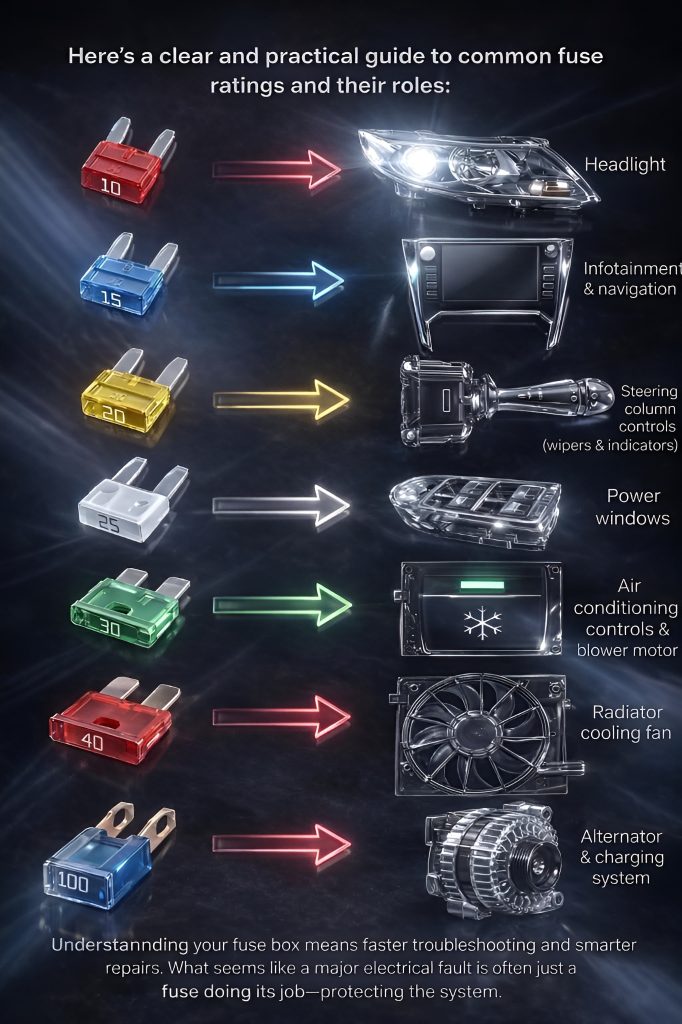
Understanding your fuse box helps you diagnose problems faster. If one system stops working, checking the fuse is always the first step. Replacing a blown fuse is cheap and simple. However, if the new fuse blows again, there is a deeper electrical problem that must be repaired.
It is important to always use the correct fuse rating. Never install a higher-amp fuse to “solve” the issue. This can cause serious damage or even fire. The fuse is designed to fail before the wiring or components do.
Modern cars have many electrical systems. From lights and infotainment to cooling fans and charging systems, every part depends on stable power. Small fuses play a big role in keeping everything safe.
For every driver, basic knowledge of fuses means fewer surprises, faster repairs, and lower costs. In many cases, what looks like a major problem is only a small plastic fuse that needs to be replaced.