In the world of car manufacturing, it’s not unusual to see fresh automakers start with a dream car and only later build a factory around that idea. But the Czinger family flipped that logic on its head. They first created a groundbreaking factory — and only then asked themselves: “What should we build to show what this system can really do?”
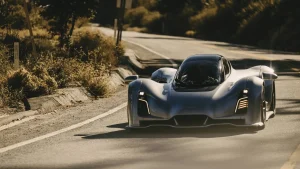
The result is the 21C, a hypercar that looks like a visiting spacecraft and drives like a fighter jet.
A Future-Proof Factory Creating a Future-Proof Car
Father and son, Kevin and Lukas Czinger, run two connected companies: Czinger Vehicles and Divergent Technologies. The first builds cars, while the second manufactures advanced 3D-printed metal components for some of the world’s top hypercar brands — Bugatti, McLaren, Aston Martin. Divergent’s production system, called DAPS, allows complete manufacturing flexibility: the factory can switch from one part to a totally different one in minutes, without changing a single piece of hardware.
Giant robots with nearly three-meter reaches assemble printed pieces into stunning structures that look like they belong in a sci-fi film.
On the racks, next to aerospace parts, lie 3D-printed components for today’s fastest hypercars — including parts for Czinger’s own creation.

It Looks Like a UFO, It Feels Like a Fighter Jet
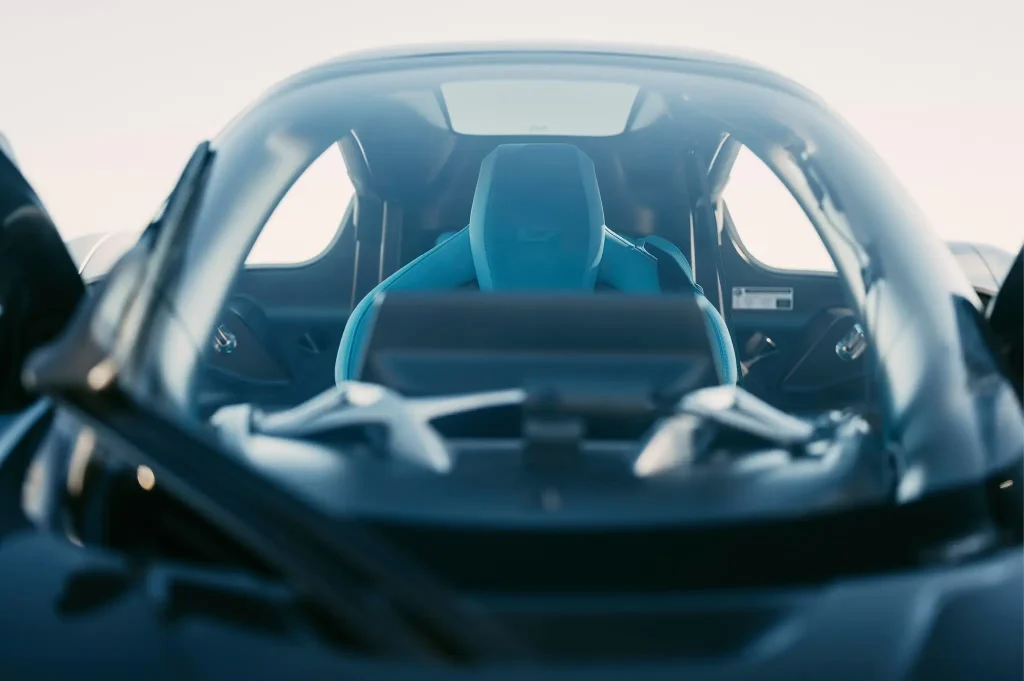
The 21C has a tandem seating layout and a cockpit that resembles a jet more than a road car. The massive double-length butterfly doors are a spectacle when opened, and getting in requires a bit of practice. But once you’re inside, you’re met with surprisingly generous space for legs and elbows.
The rear seat is interesting but awkward — the passenger has to spread their legs widely, making it far from practical for anyone wearing a skirt.
Almost every detail inside is produced in-house, from the buttons to the beautifully thin 3D-printed air vents stretching almost the full length of the doors.
A Powertrain That Sounds Like Nothing Else
Press Start, and the electric system wakes up first, powered by a 4.2-kWh battery. Switching to Sport brings the twin-turbo 2.9-liter V8 to life — an engine that spins all the way to 11,000 rpm.
Its roughly 750 hp is paired with several hundred electric horses from individual front motors and a motor-generator on the crankshaft for a combined 1,250 hp.
Despite the high idle, the exhaust note is surprisingly tame. The engine reacts instantly to the throttle, delivering a sensation closer to electric drive — quick, clean, and without vibrations — while the electric system fills in torque seamlessly.
A Racing Gearbox Behaving Better Than Expected
The 21C uses a seven-speed Xtrac sequential gearbox with a single clutch — the kind usually found in powerful race cars. Normally, such transmissions can be jerky, but the electric motors smooth everything out. They help with rev-matching, mask harshness, and make shifts surprisingly civilized.
It’s hard to believe this is a single-clutch unit at all.
Performance That Rewrites What a Hypercar Can Be
Even on the road, far from its limits, the 21C overwhelms your senses:
- regenerative braking strong enough to avoid using mechanical brakes in the canyons,
- ultra-quick steering from the central seating position that feels almost kart-like,
- and alien-sounding power delivery as energy moves between engine and motors.
On track, the numbers are absurd. At Laguna Seca, it recorded a 1:24.39 lap — faster than the McLaren Senna’s well-known record time.
Acceleration is equally mind-bending: Czinger says the 21C runs the quarter-mile in the eight-second range, right up there with the Rimac Nevera.
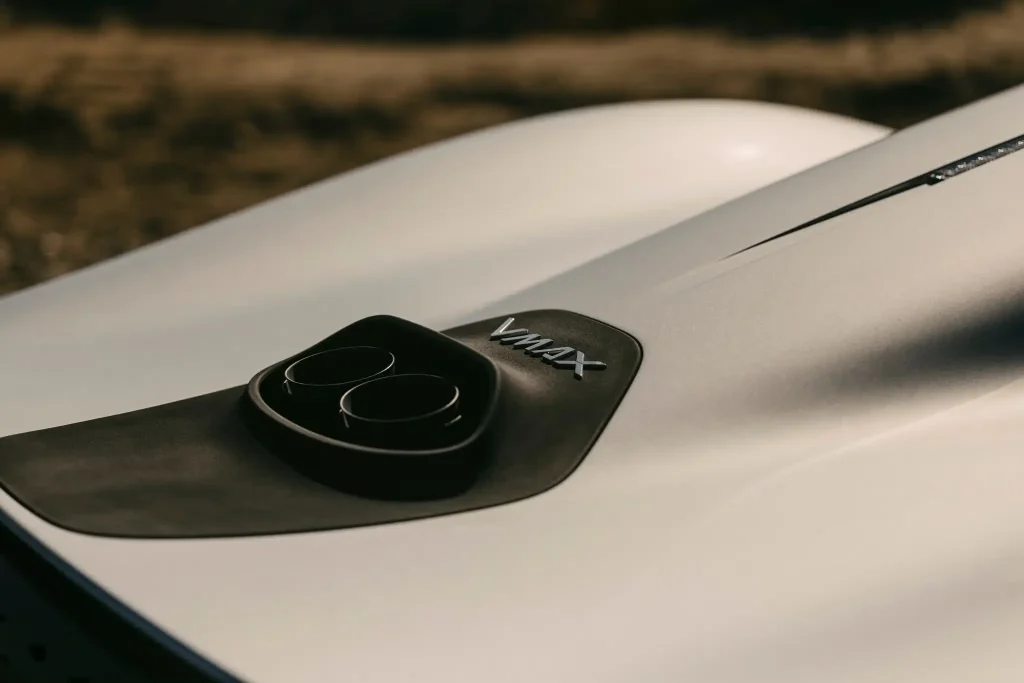
Top speed in V Max form? 268 mph (about 431 km/h).
A Few Weak Spots — but Barely Worth Mentioning
Transitioning from full throttle to hard braking can make the front end feel a bit nervous, reacting more to imperfections in the road than ideal.
Three-point turns? Probably the only thing the 21C doesn’t do well — the process is clunky.
And while the car is light with inboard suspension, the ride could be slightly better. The V Max uses the same suspension setup as the high-downforce version, just with a softer rear anti-roll bar and springs, so a more comfortable road tune could improve things.
But these are tiny critiques for a company’s very first car — especially one built primarily to show off a production method.
More Than Fast — Always Different
With a price around $2.4 million and production limited to 80 units, the 21C is far more than a performance machine.
It is built fully in California, meets crash standards, and passes CARB regulations. The factory itself holds more than 700 patents.
Everything about this car — how it’s made, how it looks, how it drives, and the records it breaks — pushes the boundaries of what a hypercar can be.
The Czinger 21C isn’t just incredibly fast. It’s a hypercar that constantly reminds you you’re in something fundamentally different from anything else on the road.
Familiar roads feel new. The driving experience is alien. People stare like it just landed from another world.
This isn’t just the next chapter for hypercars — it’s a whole new book.